
Context
This term, my JHS 3 students (two classes, 23 students total) completed a mini research project built around the King Arthur legend. JHS 3 has been practicing sustained extensive reading for the first semester through the use of a graphic novel which is projected onto a massive screen, giving it a cinematic effect. As we read, students answer 5W1H questions, building holistic comprehension around a multi-modal reading experience.
After completing the short graded reader comic, students were tasked with a research project that had two goals:
- give students hands-on practice with a basic research framework under real conditions: search, evaluate, cite
- have them use what they found to communicate in English (L2).
The task
Each student chose a symbol from the King Arthur story (Excalibur, Camelot, the Round Table, Merlin), searched for a source that connected to it, and evaluated that source on three criteria: relevance (does it actually answer the question?), authority (who made it, and are they credible?), and purpose (why does this source exist?). They then rated their own trust in the source on a 1–5 scale and explained why. The final step asked them to compare their symbol to an equivalent symbol from a different culture or story, in English.
What the data showed
A clear majority of students, 14 of 23, converged on Excalibur as a symbol of kingly status. The rest split across Camelot (kingdom harmony), Merlin (the wise teacher), and the Round Table (equality). I don’t yet know whether that convergence reflects Excalibur being the most memorable symbol in the source material, or whether the way I structured the symbol-selection options nudged students toward a shared default. It’s a question I want to look into before running this again.
Self-assessed trust in sources averaged 3.65 out of 5, with little difference between the two classes. More interesting was the gap between how students rated relevance versus authority: relevance averaged 3.91, authority averaged 2.83. In practice, most students could judge whether a source answered their question, but had a harder time evaluating who produced it and why that mattered. Authority reasoning tended to lean on a single surface cue — a well-known site name, an author being listed — rather than a weighed judgment.
A small number of responses (2 of 23) showed clear signs of rushed or incomplete work in the comparison section, which is worth following up on individually rather than reading as a skill gap.
The rubric
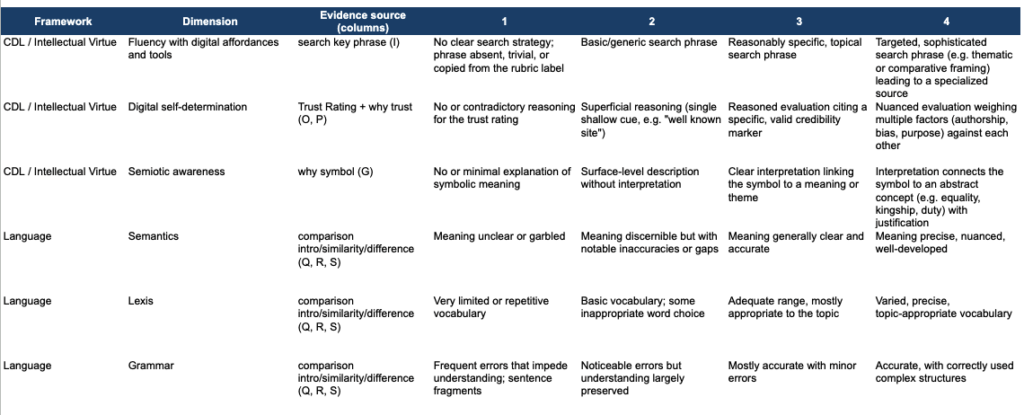
The rubric was mapped to the Critical Digital Literacy (CDL) framework that establishes intellectual virtue as its core principle. Three dimensions of CDL were extracted for assessment based on class objectives. Additionally, to service the language component of the assignment, linguistic assessment of L2 was broken into semantics, lexis, and grammar. L2 was present only in the final stage of the research when students had to synthesize newly acquired information (symbols from other cultures) with one that they already knew (from King Arthur).
Each dimension was graded from one to four, with a total score of 24 available points.
What I’m taking from this
The authority-evaluation gap is the most actionable finding here. Students have a reasonable instinct for relevance but need more explicit scaffolding around evaluating who is behind a source and what motivates them. Next time, I’d build in a step that asks students to name a specific reason to trust or distrust the author, rather than the source in general.
I also want to revisit how the symbol options are presented before I read the convergence toward Excalibur as a finding about the text rather than an artifact of the form.
This project draws loosely on a CDL / intellectual virtue framework I’m developing to assess digital research skills alongside language output. More on that framework in a future post.