
Table of Contents:
With the advancement of ICT integration in Japanese secondary education, opportunities for student presentations and inquiry-based learning have expanded significantly. At our school, students engage in an established inquiry learning module that requires examination of contemporary issues through structured, process-oriented frameworks.
However, in ICT-supported EFL classes where presentation tools such as Canva are frequently utilized, it became evident that student output often emphasized visual presentation over systematic research processes and critical evaluation of information.
Although students are required to address large scale societal issues within the SDGs framework, many lack explicit methodological guidance for conducting, evaluating, and communicating research. In response, research methods instruction was incorporated into EFL classes with an emphasis on information and media literacy to support more rigorous inquiry practices.

Integration of Research Methods in ICT-Supported EFL Instruction
Project Overview
To support authentic assessment and reduce evaluative burden, students delivered live presentations to external EFL instructors who were familiar with academic and technical language.
Through a third-party online exchange program, students from JHS Grade 2 to SHS Grade 2 engaged in English communication via video calls approximately seven times per academic year. Leveraging this structure, the project targeted Grade 1 and Grade 2 SHS students specifically, integrating digital tools such as ChatGPT and Google applications for bilingual (L1/L2) research and reporting.
Students synthesized their findings into structured Canva presentations, which were delivered online via Google Meets. The project aimed to develop research rigor alongside information evaluation skills, including lateral reading strategies.
Implementation Process
| Tools | Search Tools: Google Search, Google Gemini, ChatGPT Reporting tools: Google Forms, Google Sheets Evaluation tools: Tally.so, Google Classroom |
| Participants | Approximately 76 students in Grade 1 & 2 of senior high school |
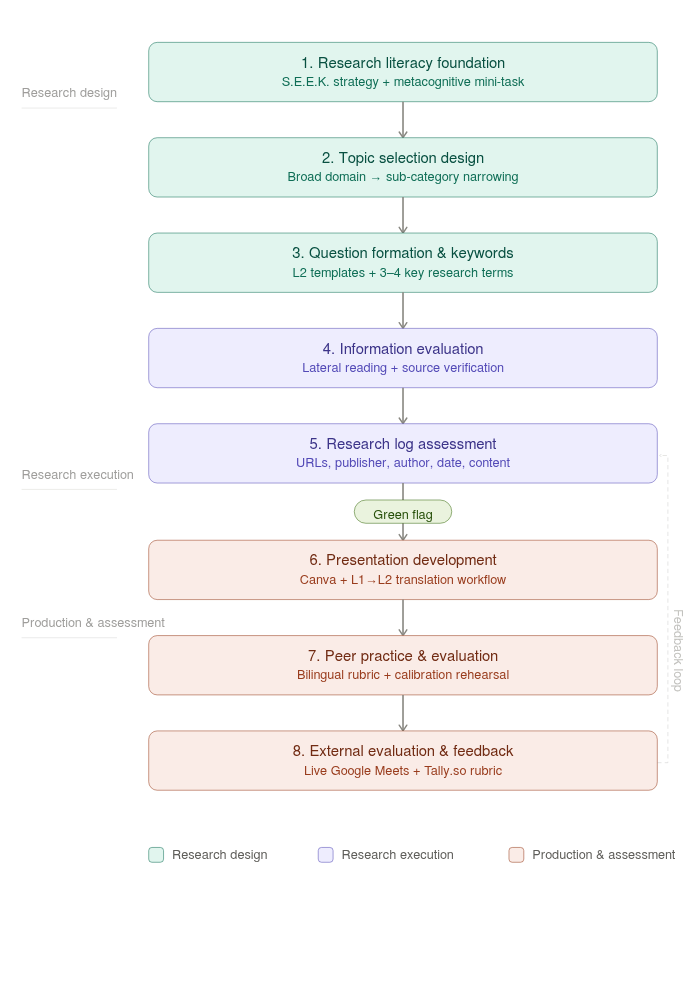
1. Research Literacy Foundation
Students were first introduced to the S.E.E.K. strategy (Commonsense.org), adapted for a Japanese educational context. To reduce cognitive load, this was practiced through a short metacognitive mini-research task involving an imaginary character’s homework. This allowed students to focus on process rather than topic complexity.
2. Topic Selection Design
To mitigate decision fatigue commonly observed when students perceive choices as long-term commitments, students initially selected between two broad domains:
- Sciences
- Humanities
At this stage, choices were intentionally low-stakes and often guided by intuition rather than workload forecasting.
Students then incrementally narrowed their focus into sub-categories (e.g., Music, Food, Culture or Astronomy, Mathematics, Biology). This step-wise narrowing supported momentum while maintaining engagement.
3. Question Formation and Keyword Tracking
Students were provided with research question templates in L2, aligned to specific research objectives (e.g., explanation, description, comparison).
- Students formulated Opening Questions
- Extracted 3–4 key research terms from each question
These keywords served as an anchor for monitoring research direction and assessing alignment between inquiry and output.
4. Information Evaluation and Lateral Reading
Students were introduced to lateral reading strategies through guided video instruction, followed by explicit demonstrations of:
- URL verification
- Publisher and organizational background checks
- Cross-source comparison
Search methods using Google Search and ChatGPT were explored in parallel. While students were already familiar with generative AI tools, structured discussion focused on information sourcing, prompt design, and verification.
Throughout this stage, students submitted a single core deliverable: a research log sheet.
5. Research Log Assessment
The research log required students to document:
- URLs
- Publisher / organization details
- Author information
- Date of publication
- Extracted content intended for presentation use
This log served as the primary artifact for assessing research process, rather than presentation polish alone.
6. Presentation Development
Upon approval (“green flag”), students proceeded to presentation creation in Canva. Workflows varied:
- Visuals-first → script later
- Script + visuals developed simultaneously
- Script-first → visuals later (rare)
Most students drafted content in L1, then translated to L2 using Google Translate or DeepL. This was permitted to prioritize coherence, meaning, and discourse flow over sentence-level accuracy. A small number of students independently composed directly in L2.
7. Peer Practice and Evaluation
Students rehearsed in peer groups using a simplified bilingual rubric, aligned with the criteria used in final assessment. This supported calibration and reduced performance anxiety.
8. External Evaluation and Feedback
On Google Meets, external EFL instructors conducted live evaluations using automated rubrics on Tally.so. The presentation was slotted for 5 – 7 minutes, after which each student and their individual EFL instructor had a Q&A session, followed by free talk. Scores and qualitative feedback were distributed via Google Classroom, ensuring timely and transparent feedback delivery.
Observations and Findings
1. Implementation Challenges
A shared Google Sheet was adopted to allow both instructor and student access for continuous updates. While this supported recursive research practices, it also resulted in version-control issues (e.g., accidental deletions), necessitating frequent restoration.
During the early stages of implementation, several procedural elements required revision while the project was in progress, which temporarily slowed overall workflow.
For instance, the research log underwent multiple iterations before a workable format was identified. Ultimately, a shared Google Sheet was adopted to allow both instructor and student access for continuous updates. While this supported recursive research practices, it also resulted in version-control issues (e.g., accidental deletions), necessitating frequent restoration.
2. Research Process Awareness
Many students began drafting presentation slides in Canva during the opening question phase, bypassing keyword extraction, research and content development.
An initial lack of separation between research design and presentation production was observed. Many students began drafting presentation slides in Canva during the opening question phase, bypassing keyword extraction, research and content development. This behavior highlighted the strong tendency among digital-native learners to prioritize output creation and underscored the necessity of explicitly structuring and enforcing research process frameworks.
3. Project Management and Platform Constraints
Monitoring student progress required additional manual oversight
Project management proved inefficient during the first half of the project due to limitations within Canva’s Classwork LMS. Assignments could not be sorted by class, and student data could not be filtered beyond completion status. As a result, monitoring student progress required additional manual oversight.
4. Learner Performance Trends
Feedback indicated generally strong performance in content development and visual design, while pacing and delivery control emerged as common areas of difficulty
Evaluator feedback indicated generally strong performance in content development and visual design, while pacing and delivery control emerged as common areas of difficulty. These results suggest that while students were able to synthesize and present researched information effectively, further instructional support is needed for oral delivery skills.
5. Student Engagement and Perceived Outcomes
Although formal exit tickets were not administered due to time constraints, anecdotal student feedback was consistently positive. Students reported high levels of engagement, appreciation for topic autonomy, and satisfaction in communicating their ideas to an external audience in a second language. These responses suggest positive affective outcomes and increased learner motivation.
Outcomes & Future Considerations
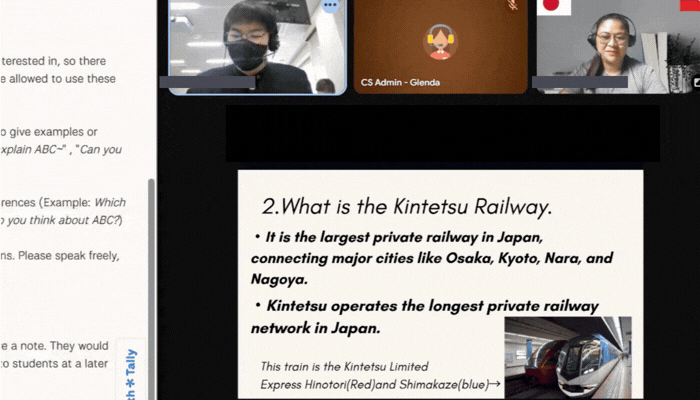
Final presentations to external instructors had an immense payoff that in-class presentations cannot replicate. Additionally, post-presentation Q&A yielded much higher engagement from student-side, as they were positioned in a place of authority with the topics that they chose and researched.
Future iterations of this project will prioritize further refinement of research process scaffolding and digital workflow design. In particular, improved research log management systems will be explored to balance shared access with version control, thereby reducing administrative burden while maintaining transparency in student inquiry. Clearer separation between research design and presentation production phases will be implemented to prevent premature output creation and to reinforce process-oriented learning. Additionally, alternative project management platforms better suited to class-based monitoring will be considered to enhance instructional oversight. From a pedagogical perspective, increased instructional time will be allocated to oral delivery skills, especially pacing and pronounciation, while preserving student autonomy and engagement. These refinements aim to strengthen methodological rigor, instructional efficiency, and the sustainability of the model for broader implementation.